Showing posts with label Motion detector. Show all posts

Saturday, January 17, 2015

Motion Detector


Motion Detector


A motion detector is a device that detects moving objects, particularly people. A motion detector is often integrated as a component of a system that automatically performs a task or alerts a user of motion in an area. Motion detectors form a vital component of security, automated lighting control, home control, energy efficiency, and other useful systems.


An electronic motion detector contains an optical, microwave, or acoustic sensor, and in many cases a transmitter for illumination. However a passive sensor only senses a signal emitted by the moving object itself. Changes in the optical, microwave, or acoustic field in the device's proximity are interpreted by the electronics based on one of the technologies listed below. Most inexpensive motion detectors can detect up to distances of at least 15 feet (5 meters). Specialized systems are more expensive but have much longer ranges. Tomographic motion detection systems can cover much larger areas because the radio waves are at frequencies which penetrate most walls and obstructions, and are detected in multiple locations, not just at the location of the transmitter.
Motion detectors have found wide use in domestic and commercial applications. One common everyday application is activation of automatic door openers in businesses and public buildings. Motion sensors are also widely used in lieu of a true occupancy sensorin activating street lights or indoor lights in walkways (such as lobbies and staircases). In such "Smart Lighting" systems, energy is conserved by only powering the lights for the duration of a timer, after which the person has presumably left the area. A motion detector may be among the sensors of a burglar alarm that is used to alert the home owner or security service when it detects the motion of a possible intruder. Such a detector may also trigger a security camera in order to record the possible intrusion.
Read More

Passive infrared sensor


Passive infrared sensor


A passive infrared sensor (PIR sensor) is an electronic sensor that measures infrared (IR) light radiating from objects in its field of view. They are most often used in PIR-based motion detectors.


How Infrared motion detector components work

  Infrared Radiation : 

Infrared radiation exists in the electromagnetic spectrum at a wavelength that is longer than visible light. It cannot be seen but it can be detected. Objects that generate heat also generate infrared radiation and those objects include animals and the human body whose radiation is strongest at a wavelength of 9.4um. Infrared in this range will not pass through many types of material that pass visible light such as ordinary window glass and plastic. However it will pass through, with some attenuation, material that is opaque to visible light such as germanium and silicon. An unprocessed silicon wafer makes a good IR window in a weatherproof enclosure for outdoor use. It also provides additional filtering for light in the visible range. 9.4um infrared will also pass through polyethylene which is usually used to make Fresnel lenses to focus the infarared onto  sensor elements.

 Pyroelectric Sensors :

The pyroelectric sensor is made of a crystalline material that generates a surface electric charge when exposed to heat in the form of infrared radiation. When the amount of radiation striking the crystal changes, the amount of charge also changes and can then be measured with a sensitive FET device built into the sensor. The sensor elements are sensitive to radiation over a wide range so a filter window is added to the TO5 package to limit detectable radiation to the 8 to 14mm range which is most sensitive to human body radiation.
Typically, the FET source terminal pin 2 connects through a pulldown resistor of about 100 K to ground and feeds into a two stage amplifier having signal conditioning circuits. The amplifier is typically bandwidth limited to below 10Hz to reject high frequency noise and is followed by a window comparator that responds to both the positive and negative transitions of the sensor output signal. A well filtered power source of from 3 to 15 volts should be connected to the FET drain terminal pin 1.
pir1.jpg (11520 bytes)
The PIR325 sensor has two sensing elements connected in a voltage bucking configuration. This arrangement cancels signals caused by vibration, temperature changes and sunlight. A body passing in front of the sensor will activate first one and then the other element whereas other sources will affect both elements simultaneously and be cancelled. The radiation source must pass across the sensor in a horizontal direction when sensor pins 1 and 2 are on a horizontal plane so that the elements are sequentially exposed to the IR source. A focusing device is usually used in front of the sensor

The figure below shows the PIR325 electrical specifications and layout in its TO5 package. Note the wide viewing angle without an external lens.
pirspec.jpg (34297 bytes)
This is a typical application circuit that drives a relay. R10 and C6 adjust the amount of time that RY1 remains energized after motion is detected. Download PDF drawing.
appckt.jpg (32281 bytes)

  Fresnel Lens_____________

A Fresnel lens (pronounced Frennel) is a Plano Convex lens that has been collapsed on itself to form a flat lens that retains its optical characteristics but is much smaller in thickness and therefore has less absorption losses.
plano.jpg (9982 bytes)
Our FL65 Fresnel lens is made of an infrared transmitting material that has an IR transmission range of 8 to 14um which is most sensitive to human body radiation. It is designed to have its grooves facing the IR sensing element so that a smooth surface is presented to the subject side of the lens which is usually the outside of an enclosure that houses the sensor.
The lens element is round with a diameter of 1 inch and has a flange that is 1.5 inches square. This flange is used for mounting the lens in a suitable frame or enclosure. Mounting can best and most easily be done with strips of Scotch tape. Silicone rubber can also be used if it overlaps the edges to form a captive mount.
The FL65 has a focal length of 0.65 inches from the lens to the sensing element. It has been determined by experiment to have a field of view of approximately 10 degrees when used with a PIR325 Pyroelectric sensor.
fresnel.jpg (35285 bytes)


This relatively inexpensive and easy to use Pyroelectric Sensor and Fresnel Lens can be used in a variety of science projects, robots and other useful devices.
Read More

motion detector circuit

Introduction to Motion Detector:

The motion detector is not only used as intruder alarm but also used in many applications like home automation system, energy efficiency system, etc. The motion detector will detect the motion of the people or objects and give the appropriate output according to the circuit. In general, motion detector uses different types of sensors like Passive infrared sensor (which will detect the motion of the person using the person body heat), microwave sensor (Microwave sensor will detect the motion of person by measuring the change in frequency from the produced beam), ultrasonic sensor (It produces acoustic signals which will detect the motion of a person) etc.  There are some motion detectors which will use different technology and include number of sensors (PIR, microwave sensor, ultrasonic sensor, etc.) to reduce the false triggering and increase the accuracy in motion detection.


Block Diagram of Motion Detector:

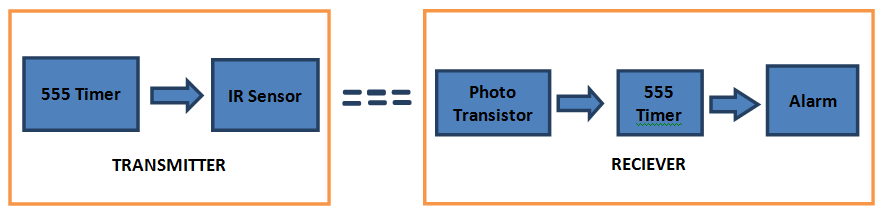
Motion Detector Block Diagram
IR sensor will produce the high frequency beam which is projected on the photo transistor with the help of 555timer at the transmitter. When this high frequency beam has got any interruption, the photo transistor will trigger the 555 timer of receiver section and gives alert through the alarm.

Motion Detector Circuit Diagram:

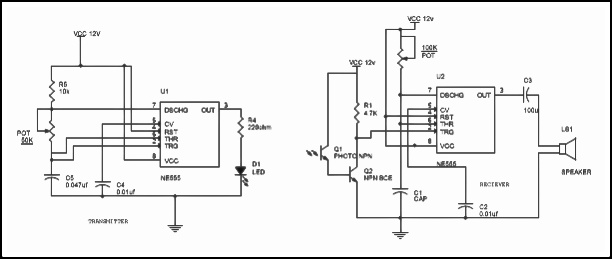
Motion Detector Circuit Diagram

Motion Detector Circuit Explanation:

  • The IR sensor will make the high frequency beam of 5 kHz with the help of 555timer which is set to astable multivibrator mode at the transmitter section.
  • The IR sensor will produce the high frequency beam which is received by the photo resistor at the receiver section. This frequency will be in one phase when there is no interruption between the IR sensor and photo transistor.  Total circuit will not give any output in this phase. When there is an interruption between IR sensor and photo transistor, the beam produced by the IR sensor will be in different phase. This different phase will be immediately detected by the photo resistor and make the 555 timer to give alarm through speaker.
  • When there is no intrusion, the photo transistor will make the pin2 high of 555timer which is set in monostable mode, and there will be no output given in this configuration. When there is intrusion, the pin 2 of monostable timer is made low which will make the alarm to alert. The alarm time depends on the capacitor C1 and variable resistor POT.
Main Components in Motion Detector Circuit:
IR sensor: the main concept of IR sensor is to produce a beam of infrared light (whose wave wavelength is longer than visible rays and shorter than microwaves, in normal infrared wave length should be greater than 6µm). IR sensors are based on three different laws they are planks radiation law, Stephan Boltzmann law and Wien’s displacement law.
  • Planks Radiation Law states that the energy of electromagnetic radiation is confined to indivisible packets (quanta), each of which has energy equal to the product of the Planck constant and the frequency of the radiation (planks constant = 6.62606957 × 10⁻³⁴ m2 kg /s).
  • Stephan Boltzmann Law states that total energy radiated per unit on a black body using  all wavelengths per unit time J* is directly proportional to the fourth power of the black body’s thermodynamic temperature T:
Formula for J in Motion Detector
  • Wien’s Displacement Law:  the wavelength of maximum emission of any body is inversely proportional to its absolute temperature (measured in Kelvin).  As a result, as the temperature rises, the maximum (peak) of the radiant energy shifts toward the shorter wavelength (higher frequency and energy) end of the spectrum.
Peak intensity occurs at this wavelength ƛ =(0.0029 meter.K)/Temperature in Kelvin
In IR sensor the infrared source and transmission of infrared are two important parts. In infrared source, there are different sources like black body radiators, tungsten lamps, silicon carbide in IR sensors. They will use infrared wavelength LED as infrared source. In transmission media it will be different like air, optical fiber etc.
Photo Transistor: Photo transistors are the detectors of IR radiation or any photo radiation. They will convert this IR radiation into current or voltage.

Applications of Motion Detection:

  • Motion detectors can be used as an intruder alarm in home, offices, banks, shopping malls etc.
  • They can be used as counting machines, automatic light control etc.
  • They can be used in energy efficient systems, home automation system and control systems.
Read More

Motion detector


Motion detector


A motion detector attached to an outdoor, automatic light.


Inexpensive Asian-made motion detector used to control the lighting

motion detector is a device that detects moving objects, particularly people. A motion detector is often integrated as a component of a system that automatically performs a task or alerts a user of motion in an area. Motion detectors form a vital component of security, automated lighting control, home control, energy efficiency, and other useful systems.


Overview


Inexpensive Asian-made motion detector used to control the lighting
An electronic motion detector contains an optical, microwave, or acoustic sensor, and in many cases a transmitter for illumination. However a passive sensor only senses a signal emitted by the moving object itself. Changes in the optical, microwave, or acoustic field in the device's proximity are interpreted by the electronics based on one of the technologies listed below. Most inexpensive motion detectors can detect up to distances of at least 15 feet (5 meters). Specialized systems are more expensive but have much longer ranges. Tomographic motion detection systems can cover much larger areas because the radio waves are at frequencies which penetrate most walls and obstructions, and are detected in multiple locations, not just at the location of the transmitter.

Motion detectors have found wide use in domestic and commercial applications. One common everyday application is activation of automatic door openers in businesses and public buildings. Motion sensors are also widely used in lieu of a true occupancy sensor in activating street lights or indoor lights in walkways (such as lobbies and staircases). In such "Smart Lighting" systems, energy is conserved by only powering the lights for the duration of a timer, after which the person has presumably left the area. A motion detector may be among the sensors of a burglar alarm that is used to alert the home owner or security service when it detects the motion of a possible intruder. Such a detector may also trigger a security camera in order to record the possible intrusion.


Sensor technology


Infrared detector mounted on circuit board, along with photoresistive detector for visible light (left)
There are several motion detection technologies in wide use:

Passive infrared 

Passive infrared sensors are sensitive to a person's skin temperature through emitted black body radiation at mid-infrared wavelengths, in contrast to background objects at room temperature. No energy is emitted from the sensor, thus the name "passive infrared" (PIR). This distinguishes it from the electric eye for instance (not usually considered a "motion detector"), in which the crossing of a person or vehicle interrupts a visible or infrared beam.

Microwave

These detect motion through the principle of Doppler radar, and are similar to a radar speed gun. A continuous wave of microwave radiation is emitted, and phase shifts in the reflected microwaves due to motion of an object toward (or away from) the receiver result in a heterodyne signal at low audio frequencies.

Ultrasonic

An ultrasonic wave (sound at a frequency higher than a human can hear) is emitted and reflections from nearby objects are received.[1] Exactly as in Doppler radar, heterodyne detection of the received field indicates motion. The detected doppler shift is also at low audio frequencies (for walking speeds) since the ultrasonic wavelength of around a centimeter is similar to the wavelengths used in microwave motion detectors. One potential drawback of ultrasonic sensors is that the sensor can be sensitive to motion in areas where coverage isn't desired, for instance, due to reflections of sound waves around corners.[2] Such extended coverage may be desirable for lighting control, where the point is detection of any occupancy in an area. But for opening an automatic door, for example, one would prefer a sensor selective to traffic in the path toward the door.

Tomographic motion detector

Tomographic motion detection systems sense disturbances to radio waves as they pass from node to node of a mesh network. They have the ability to detect over complete areas because they can sense through walls and obstructions.

Video camera software

With the proliferation of inexpensive digital cameras capable of shooting video, it is possible to use the output of such a camera to detect motion in its field of view using software. This solution is particularly attractive when the intention was to record video triggered by motion detection, as no hardware beyond the camera and computer is required. Since the observed field may be normally illuminated, this may be considered another passive technology. However it can also be used in conjunction with near-infrared illumination to detect motion in the "dark" (that is, with the illumination at a wavelength not detected by the human eye).

Dual-technology motion detectors

Many modern motion detectors use combinations of different technologies. While combining multiple sensing technologies into one detector can help reduce false triggering, it does so at the expense of reduced detection probabilities and increased vulnerability. For example, many dual-tech sensors combine both a PIR sensor and a microwave sensor into one unit. In order for motion to be detected, both sensors must trip together. This lowers the probability of a false alarm since heat and light changes may trip the PIR but not the microwave, or trees may trigger the microwave but not the PIR. If an intruder is able to fool the PIR or microwave, however, the sensor will not detect. Dual-tech sensors are only as strong as their weakest link.

Often, PIR technology will be paired with another model to maximize accuracy and reduce energy usage. PIR draws less energy than microwave detection[dubious – discuss], and so many sensors are calibrated so that when the PIR sensor is tripped, it activates a microwave sensor. If the latter also picks up an intruder, then the alarm is sounded.

Read More

About Me

Popular Posts

Designed ByBlogger Templates